The inspirational priest whose Waterford placename book was a best-seller
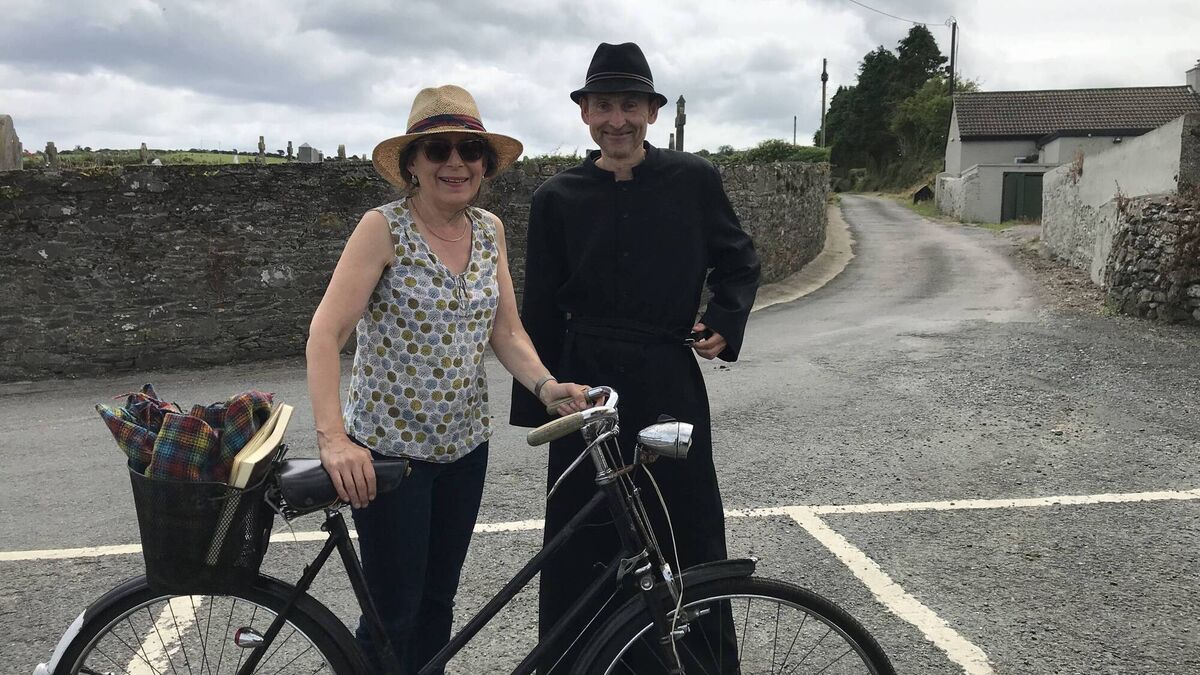
On the day of the shoot director RoseAnn Foley and actor George Macleod.
Canon Patrick Power was a quiet Waterford man with a passion for all our local place-names. His bilingual book, Logainmeacha na nDéise/The Place-Names of Decies, was a best-seller when it was first published in 1907.
When its second edition came out nearly 50 years later, in 1952, it sold out quickly. Today copies of the book are rare, and among aficionados it is a much sought-after publication.
Canon Power himself is viewed as an inspirational figure, revered by all those who study toponymy and by those who feel a pride in the antiquity and beauty of our place-names. He’s the most lauded authority on Waterford place-names and the most esteemed writer we have in this area.
Immediately on being commissioned by Máire Seó Breathnach, Irish Officer with Waterford City and County Council, to write a bilingual poem that would commemorate the place-names of Waterford I knew he would be central to whatever I created.
I sat at my desk and imagined him riding his bicycle along the lanes and byways of the county, stopping at crossroads, talking with local people, scribbling down notes about the fields he had passed, gathering information as he went. In researching the local toponymy, Power visited nearly every one of the thousands of locales mentioned in his book, examining grave inscriptions and antiquities. I knew his process would fuel my writing.
My sister, RoseAnn Foley, was commissioned to create a short film to compliment this poem. We were both excited to know that our work would be premiered at a special screening at Dungarvan Library during Heritage Week 2024.
Canon Power was born in Ballygunner in 1862. He was a priest, a historian, an academic, a writer, an archaeologist and a toponymist. He would be my guide, my way of exploring the richness of our place-names. And so my poem, Ceol na gCloch, began to take shape.
Educated at Ballygunner national school and later at the Catholic University School (a precursor to today’s De La Salle College) in Waterford, Canon Power went on to study for the priesthood at St John's College in Waterford. He was ordained in 1885 and was sent to work for three years at a mission attached to St Bride's Church in Liverpool. It was at this point, in 1888, that fate took a hand in his affairs: as he was in danger of getting tuberculosis, he was sent to Australia. While there he spent seven years in the rural diocese of Wilcannia, New South Wales, coming into contact with the Aboriginal people. This, in particular, seems to have influenced him greatly and further ignited his interest in archaeology. I found this part of his life to be fascinating. The stone music and culture of the Aboriginal people seemed to echo down the years and soon the place-names of our fields and roads were dancing across my laptop screen. My poem seemed to take on a life of its own.
I read and reread the Canon’s entries on place-names of Decies moving from east to west, from north to south, going from Lisduggan and Cleaboy, and from Ballygunner to Ballyvoyle (ó Lios Dhubhagáin agus an Claidhe Bhuidhe, ó Bhaile Mhic Gonair go Baile Uí Bhaoighill). I swung from one end of the county to the other – from Cheekpoint (Pointe na Síghe) to Barronstook (Barr na Stuac). I loved writing that poem.
On his return to Waterford in 1895, Canon Power was assigned as curate to Waterford cathedral. Later he was chaplain to the Little Sisters of the Poor. He served as an inspector of schools and chaplain to both the De La Salle training college and the Good Shepherd convent. From 1908, he was curate at Portlaw, and later he was made a canon of the diocese of Waterford and Lismore.
He lectured on Celtic archaeology in St Patrick's college, Maynooth, he was professor of archaeology in University College Cork from 1915 to 1932. He had a reputation as an engrossing lecturer and conversationalist, and for his generosity to fellow scholars and enthusiasts.
He is described as someone “with old-world courtesy and unfailing gentleness” by the then president of UCC, Alfred O’Rahilly, in the forward to the 1952 reprinting of Power’s book. Canon Power “devoted all of his scanty means to the purchase of books and manuscripts,” says O’Rahilly. He was “tirelessly devoted to his research, his only other recreation being an interest in horticulture...He was devoted solely to his subject, retaining his studious habits even to the last. At the same time one never forgot that he was a saintly priest, firm but unostentatious in his faith.”
According to the Dictionary of Irish Biography, Place-names of Decies was serialised in the Waterford and South-East of Ireland Archeological Society’s journal over many years before being published in book form in 1907. Then at the request of Waterford County Council, the Canon devoted his last years to an enlarged and revised edition of this masterwork, and the edition was published posthumously in 1952.
After his retirement from UCC he lived for some time in Youghal, before moving to a bungalow on John's Hill in Waterford city, where he died on October 16, 1951. He was buried in the historic St Otteran's cemetery, Ballynaneashagh (Baile na nDéiseach), Co. Waterford as he had expressed a wish to be interred among the district’s poor.
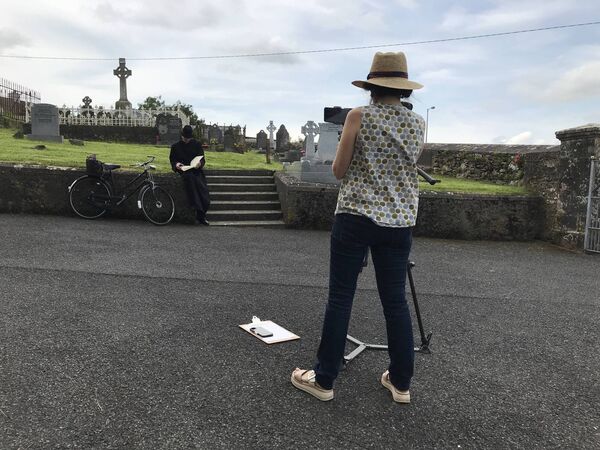
As luck would have it we at home inherited a valuable copy of his book. I turned the pages reverently. I sat down and finished my poem. I hoped it had a nice swing to it. I hoped it conveyed the musicality of the place-names. I hoped it was true to the spirit of Canon Power. Once it was ready, I delivered it to RoseAnn. Straight away she began to marshal her thoughts, and I quickly realised that her vision for the film seemed to mirror my own. She sourced a priest’s cassock, an old high nelly bicycle and she bought a pair of black laced brogues. She picked a day and we headed out for the shoot. The sun shone. Our actor, brother-in-law, George Macleod, donned the gear and filming began. Today my poem with RoseAnn’s accompanying film can be viewed on the opening page of www.deiselogainm.ie. Bainigí taitneamh as. Enjoy.