The fascinating story of the Graves' of Waterford and New Ross
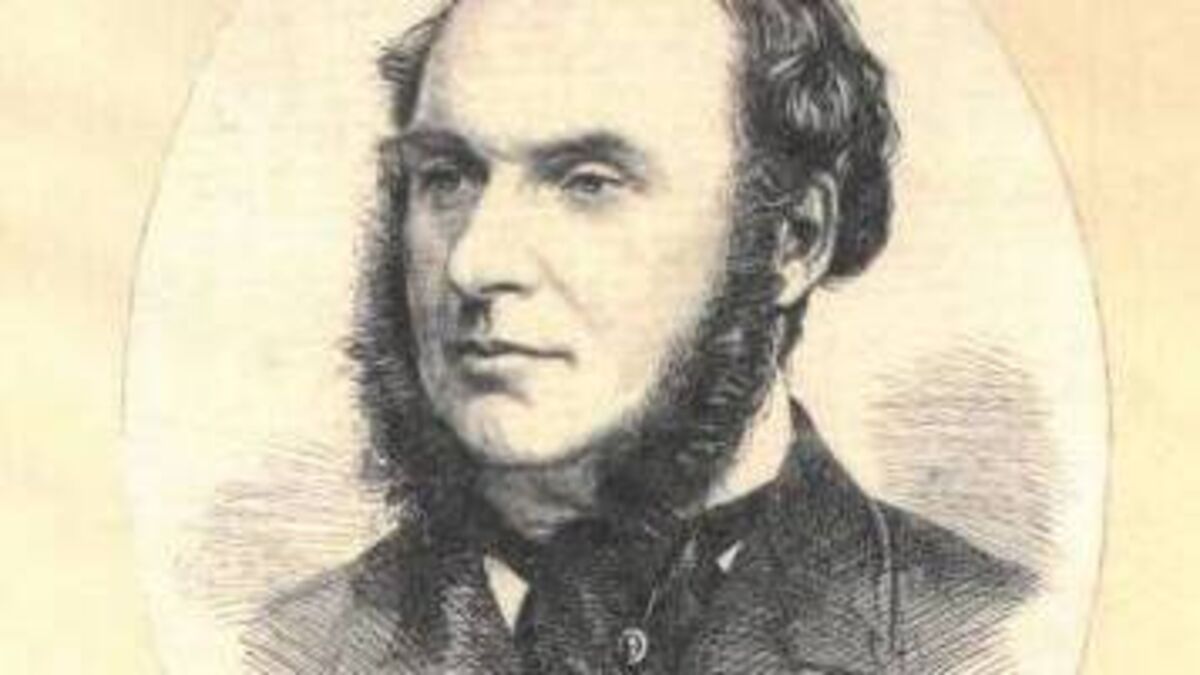
Samuel Robert Graves. Image courtesy of Liverpool Records Office. There is a statue of Samuel Robert Graves on display in St George’s Hall in Liverpool.
Whenever I hear or see the names ‘Graves of Waterford’ or ‘Graves of New Ross’, it conjures up pleasant childhood memories.
My father was a frequent customer at Graves Timber Yard on Park Road in Waterford to purchase timber and plywood for the various small boat-building projects that he undertook.
Sometimes I was allowed to accompany him, which I always looked forward to.
I can clearly recall all the smells and sounds of the activity in the busy premises, machines humming in the background, the deafening sounds of sawmills operating, the chugging sounds of cranes, lorries loading and unloading and sturdy men carrying planks across the yard.
There was a fine office building at the entrance, where payments were received as you left the yard.
As a young boy, I would not have known the extent of the Graves complex in Waterford, extending for four acres and had the advantage of having their own wharf adjoining the premises, as was the case in New Ross.
Graves & Co. at one time owned a steel barge called Rose Macrone, which plied timber between the premises.
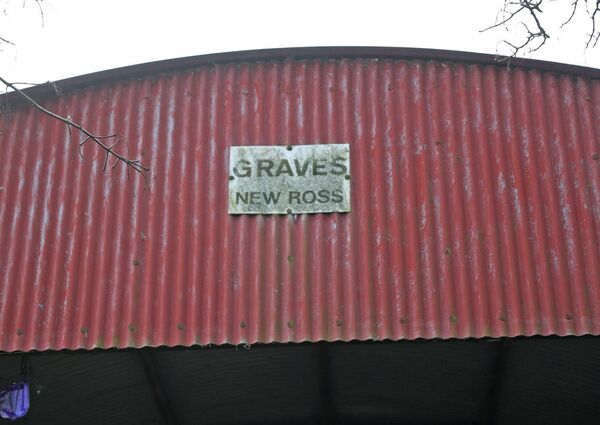
Also, when you travelled around the rural parts of Counties Waterford, Kilkenny and Wexford, every hay barn or shed that you spotted on farms, close to the road, had a sign erected at one end, telling you it had been erected by ‘Graves of New Ross.’
All the farm buildings were fabricated at the Graves Branch in New Ross.
Later, I learnt that, as far back as 1880, the firm established a license from a Danish Company to manufacture Graves Patent Roofing Felt with exclusive rights for Britain and Ireland.
This led to the famous Graves ‘Dutch Style’ hay barns, which were the first round-roofed hay barns. Graves patent roofing became world famous and was used to cover some of Ireland’s most prestigious buildings and used extensively for shelter huts and lining the trenches during World War I.
William Graves & Son: From New Ross to Savannah, c. 1840s to 1869 What I did not know then, and only found out many years later, much to my shame, was the importance of the vessels of William Graves & Son of New Ross.
From the mid-1840s through the mid-1850s, vessels belonging to Graves pioneered a connection with Savannah, the primary port in the state of Georgia, USA. Graves ships sailed from New Ross and Waterford to Québec, in Canada, and Savannah.
The sailings to Savannah took place during autumn and winter. A typical port-to-port voyage took around forty days. Ice on the St Lawrence River rendered Québec, the traditional supply-port, inaccessible during those months. Voyages were initially in ballast, but they later carried emigrants. On the return voyage from Québec, the cargo was usually timber.
The Savannah-bound ships returned to Liverpool with cotton.
Furthermore, Jack O’Leary, the late County Wexford maritime historian, noted that from 1847 to 1858, New Ross-based ships, many owned by Graves, carried 19,913 people to North America.
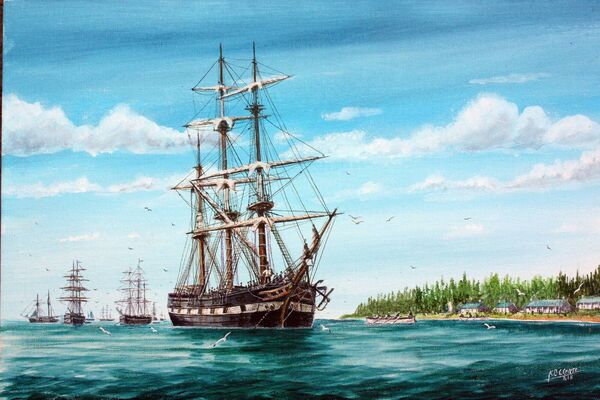
Ships belonging to Graves were well regarded for their low mortality rate. The most famous of these was the 458 tonne, three-masted barque, Dunbrody, built in Québec in 1845 by Thomas Hamilton Oliver.
Dunbrody had been built solely as a cargo vessel, but in 1847, because of the famine and a shortage of passenger vessels to carry the large exodus of people, escaping starvation, to North America, she was, along with other transatlantic vessels, converted to carry passengers.
It is documented that in the 11 years from 1847 until 1858, Dunbrody only recorded a total of seven mortalities on board.
In 1869, after 24 years of service with the Graves family, Dunbrody was sold.
Samuel Robert Graves (1818-73): Mayor of Liverpool, 1860-61 The Graves family originated in Thomastown, Co. Kilkenny. Anthony Graves, a banker from the town, moved his family to New Ross in 1805, establishing himself as a merchant.
His son, William, established the family business in 1811 at the Block House, The Quay, New Ross.
By 1815, he was engaged in the emigration trade from New Ross to Québec, in partnership with his brother-in-law, Samuel Elly.
By 1825, the company owned four ships on that run. The company ceased trading in 1827. Mr Graves founded another company with a Mr Watson.
Graves moved their headquarters to Waterford in 1851.
William Graves, who lived at Rosbercon Castle, had four sons. The most famous of the four Graves brothers was Samuel Robert Graves, born on June 7 in 1818.
Samuel Robert is credited with expanding the business interests to Liverpool, building a successful shipping fleet of over 40 vessels.
On September 6, 1848, he married Elizabeth Anne, daughter of Samuel and Sarah Haughton of Burrin House in Carlow.
They had six children, three boys and three girls. Harriet, a sister of Elizabeth Anne, married Anthony Elly Graves (Samuel Robert’s brother) in 1850.
Samuel Robert began business in Liverpool in 1846. He went on to gain many notable distinctions.
A trading office and warehouse was opened in Oriel St, Liverpool, under his watchful eye. He was elected Chairman of the Liverpool Shipowners’ Association from 1856-9.
In 1857, he was elected to Liverpool City Council for the No. 8 or Pitt Street Ward. Subsequently, in 1858, he was elected a member of the Mersey Docks and Harbour Board.
In the 1857 general election, Samuel Robert had been a candidate for the Borough of New Ross.
He had advocated a reduction in income tax and a continuance of the grant to Maynooth College. Graves’ candidature was unsuccessful on that occasion.
Samuel Robert Graves was elected Mayor of Liverpool in 1860-61, the first Irishman ever to achieve that distinction.
He was Commodore of the Royal Mersey Yacht Club and was, reputedly, a friend of Queen Victoria and her son, the Prince of Wales, whom he entertained on a regular basis.
Graves was a member of the Royal Commission to inquire into the management of Lights, Buoys and Beacons, and held many directorships, including one in the London and North-Western Railway Company and in the Pacific Steam Navigation Company.
He was author of ‘National Dangers’ and ‘A Cruise in the Baltic’.
This latter book, which still can be obtained from antiquarian bookshops, is a fine account of a 10-week cruise in the summer of 1862 sailing on the yacht ‘Ierne’ from Fort William on the west coast of Scotland, through the Caledonian Canal, and into the waters of the Baltic.
It is interesting, both as an account of a mid-19th century yachting cruise and as an excellent descriptive account of Denmark, Sweden, and Russia at that period.
Moreover, on July 14th, 1865, he was elected as a Conservative MP for Liverpool. Graves held his seat at the next General Election in 1868, polling 16,766 votes, the highest recorded by any borough member.
The Liberal Party was in power at the time, firstly under Lord Palmerston and later William Gladstone. Samuel Robert Graves spoke in the House of Commons, on many occasions, in debates concerning Naval or Irish matters.
Sadly, on January 18, 1873, aged 54 years, Samuel Robert Graves died unexpectedly from a heart attack.
The Illustrated London News eulogised him as “one of the prominent members of Liverpool’s great mercantile community”.
In 1874, the Conservative Party, under Benjamin Disraeli, returned to power.
This was the election that saw the Irish Home Rule Party become a significant third party in Parliament, winning 60 seats. It has been stated that Samuel Robert Graves would have been appointed a Conservative Party cabinet member if he was still alive.
From Annefield to Anfield: Graves connection to Liverpool FC It was not only in shipping and political affairs that Samuel Robert Graves made his mark on life in Liverpool.
He also bequeathed a legacy to Liverpool that has endured to this day – a venue that has given so much pride and pleasure to generations of Liverpudlians. In his capacity as Lord Mayor, Graves put through a proposal to develop grounds on the outskirts of the city for football.
Football was in its infancy in England around this time, with the desire for clubs to find a common code being the impetus behind the foundation of the Football Association in 1863.
The football grounds ran directly behind the family business.
It has been said that Samuel Robert Graves was credited with giving the land free of charge.
He then sanctioned a proposal to build a roadway up to the new grounds. Graves duly named it Anfield Lane, after the one beside his ancestral home in New Ross, which was in the townland of Annefield.
Annefield Lane ran just above Rosbercon Castle and the name ‘Annefield’ was chosen for the home of Samuel Robert Graves in Liverpool.
Later shortened to Anfield, it became the name of a district in Liverpool and today survives most famously as the name of one of the most iconic football stadiums in the world, home of Liverpool Football Club – Anfield Stadium.
Samuel Robert Graves had died before Everton Football Club was founded in 1878, thus did not witness them playing at the Anfield ground from 1884 until 1891.
A dispute over rent in that year saw Everton move to nearby Goodison Park. Anfield has been the home of Liverpool Football Club since it was founded in 1892.
On August 24, 2025, Everton played their first competitive match versus Brighton & Hove Albion, at their new Hill Dickinson Stadium.
The new stadium is in the former Bramley-Moore Dock, an area that had become run-down and neglected. It is vastly different from the hustle and bustle of the Victorian era when shipping magnates, such as Samuel Graves, thrived on the banks of the Mersey.
The new stadium, designed by the famous US architect Dan Meis, does reflect tradition and modernity – four brick-clad stands in keeping with nearby warehouses, topped by a futuristic curved barrel roof.
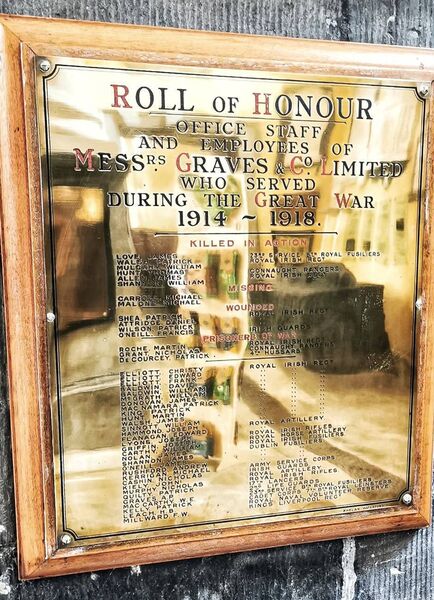
Graves & Co. in the 20th Century Today, a bronze plaque is on permanent display in Christ Church Cathedral in Waterford. It contains the names of staff and employees of Graves & Co., who served in the Great War, 1914-1918.
The plaque was originally to be seen at the company office in Waterford and subsequently donated to the Cathedral.
The name AP Graves appears on the memorial. This is Alan Percy Graves, the only son of Anthony Elly Graves and Margaret Massey Napper, who resided at Rockenham House, Ferrybank, Waterford, and grandson of Anthony Elly Graves, who died in 1891.
The younger Anthony Elly died suddenly on October 16, 1917, while motoring from Waterford to New Ross to attend a meeting of the Directors of Cherry’s Brewery.
AP Graves, who had joined the 2nd Life Guards and was still stationed in France at the time of his father’s death, was unable to return for the funeral.
In 1929, he married Countess Marie-Luise zu Dohna at Buckow, Germany, and at the commencement of World War II, he was British Military Attaché in Berlin.
Following the death of Mr Anthony Elly Graves in 1917, the business was taken over by Haughton's of Cork. The Cork Haughton's, a prominent Quaker family, would have been related to the Carlow Haughton's.
As we read earlier, Samuel Robert Graves had married Elizabeth Anne Haughton of Carlow.
In 1934, the company was taken over by Robert Elmes and Edward McBride as majority shareholders.
The Elmes' connection with the business, in fact, went back as far as 1886, when a Samuel Robinson, married to Florence Elmes, joined the company. Robert Elmes joined in 1898, becoming Company Accountant in 1913. Edward McBride joined in 1906.
Members of the McBride and Elmes families continued to pay prominent roles in the company for many years.
The company was a substantial employer in both Waterford and New Ross, with up to 180 employees in the 1960s.
Interestingly, like the Graves of old, the Elmes and McBride family members were keen sailing and boating enthusiasts. David McBride was a leading helmsman in the Enterprise dinghy class at Waterford Harbour Sailing Club during the 1960s and 70s.
However, in December 1971, Graves was sold to Tony O’Reilly’s Fitzwilton Group, who also owned Dockrell’s Builders Providers, Dublin and Cork. In 1990, ownership changed to the Brooks Thomas Group, who changed the name, and so the once immensely proud and long-established name disappeared from New Ross and Waterford after almost 180 years in business.
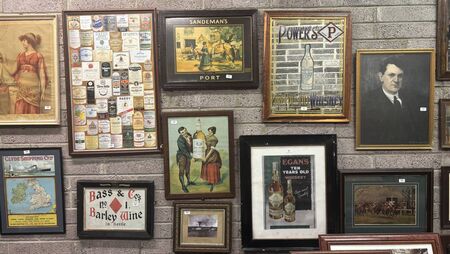
In 2011, to mark the bicentenary of the founding of a family business by William Graves at New Ross in 1811, a very pleasant celebration took place. Mark Elmes, a grandson of Robert Elmes (joined 1898) and Edward McBride, a grandson of his namesake, Edward McBride (joined 1906) curated and displayed a diverse collection of memorabilia, gathered over many years, in addition to giving an illustrated talk on the company history.
Conclusion The story of Graves & Company has been a personal journey of discovery for me. Cherished childhood memories of seeing the name ‘Graves’ on hay sheds, dotted around the countryside and the sounds of the timber yard, located off Waterford’s Park Road, are now elevated with the important knowledge of the status, held by Graves & Company, in the maritime, commercial and political history of New Ross, Waterford, Liverpool, Canada and the United States.
Graves & Company is a story of a prominent and long-standing business, founded in New Ross, in the early 19th century, later expanding to Waterford and maintaining deep roots in the maritime, emigration, and industrial history of these two ports until the late 20th century.
In particular, Graves were especially involved in the emigrant trade to Canada and the United States, operating ships like the Dunbrody. They later diversified into timber sawmills, felt manufacturing, and builders' supplies. In addition, the family also had significant interests in Liverpool and North America, with Samuel Graves, as we have read, becoming a prominent figure in Liverpool politics and business.
Graves & Company continued to operate through World Wars I and II, providing much-needed employment.
It is a story that should not be forgotten.
Acknowledgements Many thanks to the following for their generous assistance in compiling this article: Cian Manning, Brian Cleare, Brendan Grogan, Liam Ryan, Joe Falvey, Liverpool Records Office, Peter McDonald, Edward McBride and Mark Elmes.