SNAs protest in Waterford City: "We're run ragged"
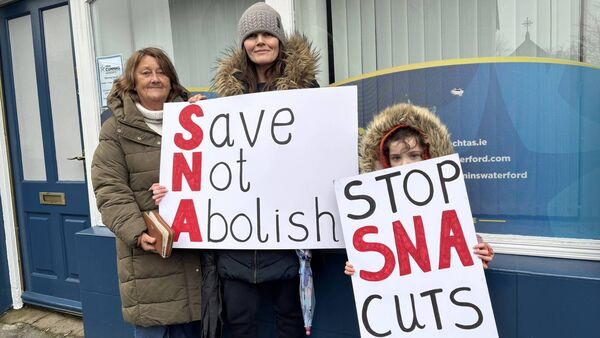
Eleanor McCartney, Roisin Ryan and Piper Ryan pictured protesting outside of Waterford Minister of State John Cummins' office.
Protesters gathered outside the Parnell Street office of Waterford Minister of State John Cummins on February 25, protesting recent controversies surrounding SNA allocation.
Following 584 reviews from the National Council for Special Education (NCSE), two-thirds of schools across Ireland were informed their SNA allocation for 2026 would stay steady or grow. 194 schools were due to have their allocation cut.
SNA reallocation can take place due to changes in school numbers or changes in care needs, according to the Department of Education.
Controversies arose as schools and SNAs struck issue with an alleged lack of communication. SNAs say they were left with scant detail over potential redeployments.
Political pressure led to Government freezing further reviews. On Monday, 23 February, Government provided an extra €19 million to prevent SNA cuts in any school across the country.
While the news has offered temporary respite, SNAs at the protest said they still fear for their job security when reviews are projected to resume in 2027.
Mary Burke works as an SNA in Ballyduff National School, Kilmeaden. She said that the current structure of the SNA system and cycle of reviews lends itself to major instability.
“At the end of November (2022), SENOs (Special Education Needs Organisers) contacted the school to say that hours were being cut from the Christmas holidays,” she said.
“They (SENOs) didn't come in and do a review. They didn't do nothing to let us know why they were cutting the hours, just that they were cutting the hours, and I lost my job.”
Ms Burke said she was out of work for 11 months and had to “claw back” hours at the school on a part-time basis.
She works in a mainstream school, which are typically more vulnerable to job cuts- dedicated special classrooms will normally have a guarantee of two SNAs.
There are three SNAs amongst 240 students at Ballyduff National School. Ms Burke said each class would have at least one child who would require an SNA throughout the school day.

“We're run ragged, the three of us…to think that they could come in and justify cutting hours from a mainstream school like that without really thinking about it, it doesn't make any sense.
“I'm just running from one child to another, and you're trying to give them five, maybe ten minutes.
“Sometimes you get caught with a child that might kick off. So you could be 25 minutes, or half an hour with that child, which means the other child you were to go to is now missing out on their break.”
Ms Burke said the redeployment scheme means that she could be assigned to a different post at the other end of the county, potentially uprooting her life in the process.
Siobhán Spillane is an SNA at Piltown National School. Like many SNAs, she feels that the underpinning regulation and guidelines are out of step with the day-to-day demands her role requires.
A Department of Education circular document from 2014 says that SNAs are allocated on the basis of students’ primary care needs (assistance with feeding, toileting, mobility, etc).
Secondary care needs can include assisting teachers, aiding with planning, and maintaining a care monitoring plan for pupils.
“It’s not primary care, but there are so many other needs that children have in primary school and secondary school, so we have a lot of children with regulation needs, social and emotional needs, behavioural needs, a lot of regulation breaks, support in other ways besides primary care,” said Ms Spillane.
“It just needs to be reinvestigated and the freeze needs to be stopped.
“No cuts, no taking childrens’ SNAs away from them, to move them to another school, taking them from mainstream children to put them into special classes. You know, the mainstream children have as many needs as children in special classes.”
Speaking to Claire Byrne on Newstalk radio about the SNA controversy, Tánaiste Simon Harris said the Government “got this wrong.”
“The reality of the situation is when something goes wrong, you’ve got to put your hands up and you’ve got to fix it.
“What I heard from parents across the country, what I heard from SNAs and what I heard from teachers was that the sequencing here matters.”
Speaking at the protest, Fórsa trade union Education spokesperson Gary Honer said attention should be put towards overhauling Circular 30.
“This is a problem caused by a lack of resources and funding, a problem that politicians were able to solve overnight by finding an extra €19m.
“They should have done that in the first place and saved schools, students and SNAs 3 weeks of worry and stress.
“We now need to bring together all of the organisations that have come to the support of SNAs and build a massive campaign to force the Government and the NCSE to recognise the full role of the SNA including SNAs in mainstream classes.”
In a statement issued to the before Government announced their intention to secure every SNA position across all schools, a spokesperson for Minister Cummins accused Sinn Féin of promoting “misinformation” around SNA provisions.
“There are no cuts to SNA provision in Waterford. Indeed the number of SNA posts across Waterford schools has increased by 58% since the 2020/21 school year (354 to 560) and the number of special education teacher posts have increased by 30% (374 to 487),” the spokesperson said.
“Nationally the number of SNA’s in schools has increased by 45% since 2020 and an additional 1,700 SNAs will support children in the next academic year 2026/27.”
“In the last two academic years alone 28 additional special classes have been sanctioned across Waterford.
“The overriding principle here must be ensuring those pupils with special educational needs are fully supported in their school setting.”