It's the most flooderful time of the year - west Waterford concerns
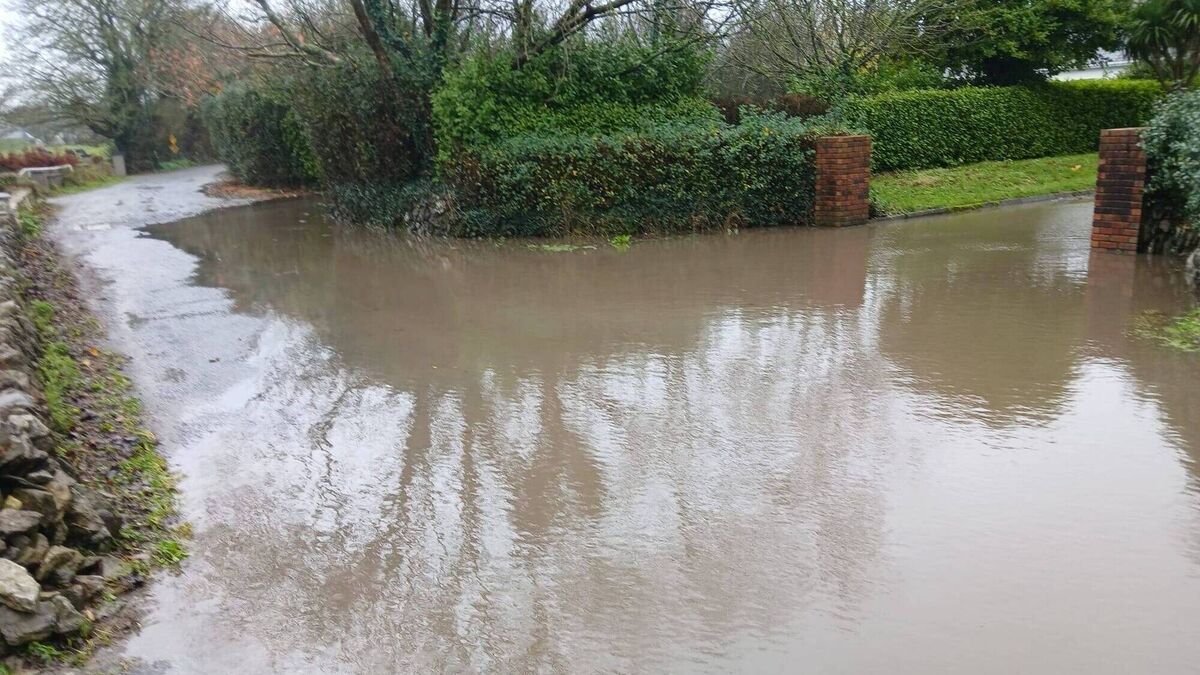
A photo of a previous year's flooding in Clashmore.
Flooding was the theme of the December sitting of the Dungarvan-Lismore District Council.
Cllr Thomas Phelan first broached the subject. He said there had been severe flooding in Ballinacourty, Clashmore. He asked if the council would “at least try” a soak pit.
“The problem is only going to get worse with increased yellow and orange rain warnings as climate change worsens.”
Cllr Phelan said Clashmore was “impassable” recently, and “the bin lorry couldn’t even go down the road”, and residents had to bring their refuse to the civic amenities site themselves at an extra cost.
Director of Roads Gabriel Hynes said, “There’s no easy solution to flooding. Soak pits are a temporary measure, they give a small bit of alleviation. I’m not committing to any works there because there’s a considerable cost involved and a limited number of households affected and I don’t have a source of funding.”
Cllr. Damien Geoghegan raised the issue of Brigid’s Terrace in Dungarvan. He told the council that when the road was resurfaced, one or two of the gullies were covered over.
“There was a very large build-up of water at the junction of St Brigid’s Terrace and O’Connell Street.”
He asked for the gullies to be reinstated “as quickly as possible”.
Cllr Tom Cronin said, on the way into Clashmore village from the Kinsalebeg side, “I’ve been on about it for years.”
He claimed that the surface on the road was dug up and people are walking close to a concrete drain “which was put in years ago and is probably not fit for purpose”.
Cathaoirleach Niamh O'Donovan said that the bend at Cappoquin post office “is constantly, dangerously pooling with water”.
She said that the pooling is “lethal” because the bend is on a national road and “people are going 100km per hour”.
Mr Hynes responded that the flooding at Cappoquin is “certainly one of our priorities”.
Cllr Niamh also raised the issue of flooding on the Clashmore road by the Welcome Inn pub.
“The water had fully crossed that road in recent days.”
Mr Hynes responded: “We had a saturated ground with a considerable amount of water coming out of gates and gaps. At this time of year, leaves are falling down into the gullies. We’ll have a look at it.”
On a positive note, Mr Hynes told the councillors that the OPW has provided funding to carry out a feasibility study in Tallow, to see if the Council can provide some form of hydrobreak that would reduce the amount of water that’s running down into Tallow.